Crostic Guru - Guess The Words
- 4.7
- Rating
- 1.00M
- Installs
- Free
- Price
 Analysis by App-foxy
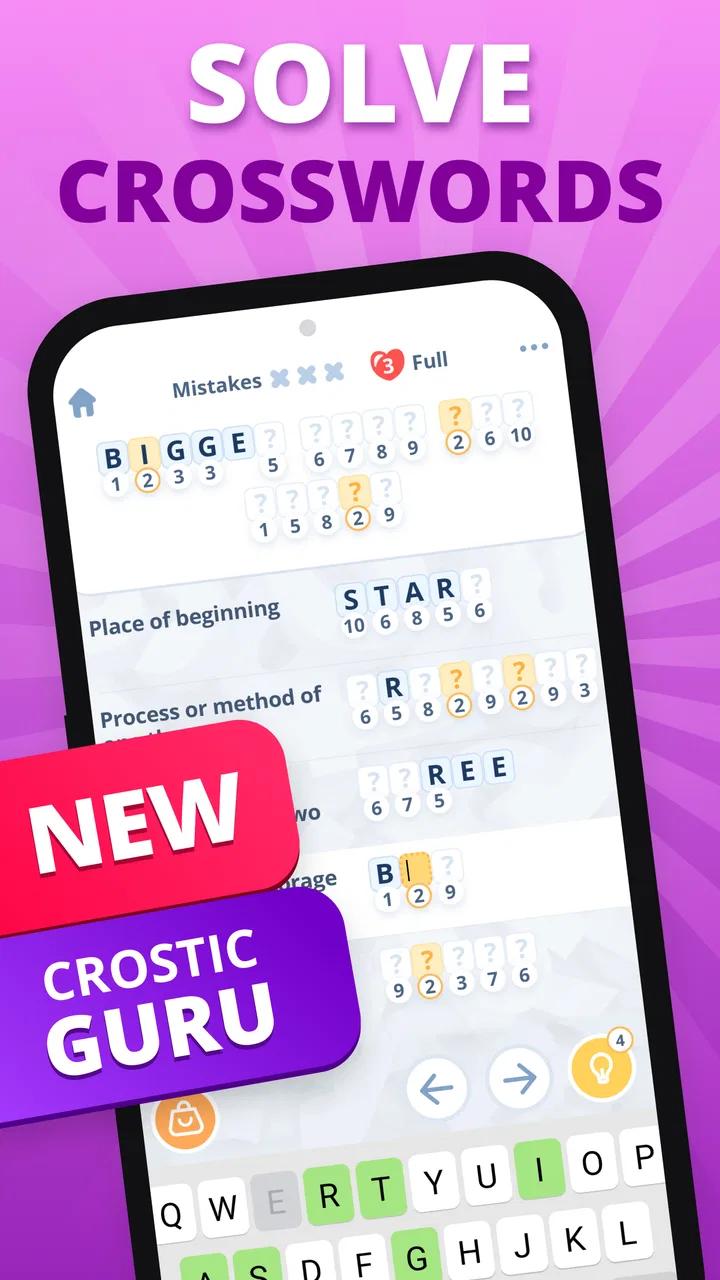
I approached Crostic Guru as a quiet word game rather than a fast-paced challenge, and that turned out to be the right expectation. It belongs to the crossword and word-puzzle side of mobile gaming, built around solving figgerites by working out the hidden words. The basic appeal is simple: you look at the puzzle, think through possible answers, and enjoy the small satisfaction of fitting the right word into place.
That simplicity makes it easy to start, but it does not make every puzzle effortless. The best moments come when a clue or letter pattern seems vague at first, then suddenly becomes clear after I look at it from another angle. I would recommend it to someone who likes short thinking sessions, vocabulary games, and traditional word puzzles without the pressure of timed action. I would not choose it for someone looking for a story, competitive multiplayer, or a game that constantly changes its rules.
What to expect from this word-puzzle game
The game is developed by Severex and is free to play, with optional purchases priced from $2.49 to $7.99 per item. It is rated for Everyone, so its general presentation is suitable for a broad audience. The current version is 1.8.1, and it runs on Android 8.0 or later. Those details make it a practical choice for people using older compatible phones as well as newer devices.
You May Also Like

 Blood Strike: 2.5 Anniversary
Blood Strike’s Loadouts Turn Every Drop Into a Tactical Gamble
A close look at Blood Strike’s custom loadouts: how fast access to signature weapons reshapes its battle royale rhythm, rewards preparation, and narrows the gap between fights.

 Pandora - Music & Podcasts
Pandora’s Music Is Easy to Start, but Harder to Recover
Pandora’s strength is its low-effort path from a seed to a station. Its weak spot is how much confidence it asks you to place in connection, setup, and quiet recovery.

 8 Ball Pool
 Is Built on Rivalries, Rematches, and Routine
A close look at the rivalries, rematches, shared routines, and unanswered safety questions that turn a quick pool match into a persistent mobile community.

 Samsung Music
’s Quiet Strength Is Playing What You Already Own
Its reach comes less from spectacle than from dependable access to a personal library. That simplicity is both the app’s strongest retention engine and its ceiling.

 AccuWeather: Weather Radar
AccuWeather Review: A Quick, Clear Forecast for Everyday Decisions
For everyday plans, the best forecast is the one you can understand quickly. AccuWeather makes rain timing, radar, and local conditions easy to act on, with a few trade-offs.

 Hill Climb Racing
Why Hill Climb Racing Still Turns Crashes Into One More Run
A tiny car, a bumpy hill and one more upgrade: Hill Climb Racing keeps resurfacing because its simple chaos makes every near-miss feel personal.
More From Our News Desk



The store describes the central activity as solving classic crossword puzzles of figgerites, and in practice the experience feels more focused on recognizing and guessing words than on navigating a large game world. You are not installing a complicated role-playing system with tutorials, characters, or equipment to learn. The main task is to concentrate on the puzzle in front of you and make progress one answer at a time.
That focus is the game’s biggest strength. I can open it when I have only a few quiet minutes, work on a word, and stop without feeling that I have abandoned a larger mission. It suits a bus ride, a coffee break, or the last few minutes before bed. It also works well for players who prefer games that reward patience and language knowledge instead of quick reactions.
The audience response is encouraging: Crostic Guru has a 4.7 average from around 26 thousand ratings and has passed one million installs. I would not treat those figures as a guarantee that every puzzle will suit every player, but they do suggest that the format has found a substantial audience. The important question is whether you enjoy the particular rhythm of guessing, checking, and revising words.
The first launch and the right mindset
For a first-time player, the most useful adjustment is to avoid treating every unanswered space as a sign that you are stuck. Word puzzles often become easier when I solve the parts that feel obvious first and leave uncertain areas alone for a moment. A partial pattern can reveal the answer later, especially when several letters begin to support the same possibility.
I also recommend starting with a relaxed goal. Instead of trying to finish a whole session immediately, aim to understand how the puzzle presents its clues and how completed answers help you continue. This makes the first few minutes feel like learning the game’s language rather than taking a test.
The free entry point is helpful here. You can decide whether the puzzle style fits your habits before spending anything. Optional purchases may be useful to a player who wants extra assistance or a smoother path through difficult moments, but I would first play naturally and see whether solving without help is the part you enjoy most.
How I reached the first meaningful success
My most reliable opening approach was to scan the entire puzzle before committing to a difficult answer. I looked for the shortest or most familiar-looking words first, then used those letters to make longer possibilities easier to recognize. This is more effective than staring at one stubborn area for too long, because a solved section can provide the missing context elsewhere.
When an answer seemed almost right, I checked the surrounding pattern instead of forcing it. A familiar word can still be wrong if one letter conflicts with another entry. That small habit prevents a chain of guesses from making the rest of the puzzle confusing. In a game based on word recognition, accuracy matters more than speed.
A useful everyday scenario is a short evening break. I might open the game after finishing dinner, solve the obvious entries, and leave the harder ones until my attention feels fresher. Because the experience is centered on individual puzzles, it does not demand the same uninterrupted commitment as a long-form game. That makes it easier to fit around ordinary routines.
The first real success is not necessarily completing the most difficult puzzle. It is understanding that progress comes from combining small discoveries. One confirmed word can change the shape of several uncertain guesses. Once that clicked for me, the game felt less like random guessing and more like a process of narrowing possibilities.
Where new players may feel confused
The word “figgerites” may be unfamiliar if you usually play standard crossword apps. I found that the safest approach is to focus on what the puzzle asks you to do rather than expecting it to behave exactly like a newspaper crossword. The central skill remains vocabulary and deduction, but the presentation can make the solving process feel different from filling a conventional grid.
Another common source of frustration is assuming that the first plausible answer must be correct. Mobile word games often encourage quick tapping, yet this format rewards checking how an answer interacts with the rest of the puzzle. If one guess creates awkward letter combinations around it, I treat that as useful feedback and reconsider rather than repeatedly trying to force it.
Hints can also change the way the game feels. If I use assistance too early, I lose some of the satisfaction that comes from making the connection myself. On the other hand, refusing every form of help can turn a relaxing session into a tedious one. My practical rule is to spend time on the puzzle first, then use help only when I am no longer learning from the attempt.
That trade-off is especially relevant because the game includes in-app purchases. A player who wants a completely self-contained puzzle experience should be comfortable ignoring optional spending. Someone who dislikes any purchase prompts or prefers a fixed-price app may find a traditional paid crossword alternative more comfortable, even if it offers fewer casual conveniences.
Three habits that make solving smoother
Collect easy letters before chasing clever answers. Familiar words provide structure. I found that solving several straightforward entries often made a previously unclear word much easier to identify.
Use contradictions as clues. When a guess makes nearby patterns look unnatural, that is not wasted effort. It tells me which assumption deserves another look and helps prevent blind repetition.
Pause instead of spending immediately. A short break can be more valuable than forcing a solution. Returning with a fresh view often reveals a word that seemed invisible during the first attempt.
These habits are more useful than trying to play quickly. Crostic Guru is not at its best when treated like an arcade game. Its appeal comes from the slow accumulation of certainty, and rushing tends to replace that with guesswork.
How it compares with familiar alternatives
Compared with a standard crossword app, this game feels more approachable for someone who enjoys word discovery but does not want to begin with a dense, intimidating grid. Traditional crosswords can reward broad general knowledge, including names, cultural references, and specialized clues. Crostic Guru is a better fit when you want the focus to stay on identifying words through the puzzle’s own structure.
Compared with a daily word guessing game, it offers a less restricted rhythm. Daily formats often create a single shared challenge and a strong sense of routine, while this game is more suitable when I want to solve at my own pace. The trade-off is that it may not provide the same social ritual or competitive conversation that surrounds a one-puzzle-per-day experience.
It also differs from an anagram game. Anagrams emphasize rearranging letters quickly, whereas Crostic Guru asks for more contextual deduction. If you enjoy racing a clock or producing many words from one letter set, another word game may be more exciting. If you like the feeling of gradually making a puzzle coherent, this one is more likely to hold your attention.
For language learners, the game can be useful as a light vocabulary exercise, but I would not treat it as a structured language course. It may expose you to words you do not use every day, yet it does not replace lessons, pronunciation practice, or guided grammar work. Its value for learners is informal: recognizing patterns, testing spelling, and becoming more comfortable with word shapes.
Who will enjoy it, and who should skip it
I think Crostic Guru is a strong match for casual puzzle players, crossword fans, older children who enjoy word challenges, and adults who want something mentally engaging without a complicated control scheme. The Everyone rating supports its broad accessibility, while the low barrier to entry makes it easy to try during a spare moment.
It is also a good choice for people who like solving alone. There is no need to coordinate with another player or maintain a long session. I can approach it as a small daily habit, a way to occupy a quiet wait, or a gentle alternative to scrolling through social feeds.
I would skip it if your priority is action, narrative, exploration, or constant novelty in the form of new mechanics. I would also be cautious if you dislike word puzzles that occasionally depend on a word not immediately familiar to you. In those cases, a visual puzzle, a fast anagram game, or a story-driven title may provide a better kind of challenge.
Players who are highly sensitive to optional purchases should make that part of the decision before settling in. The game is free to start, but the presence of items costing $2.49 to $7.99 means it is not the same proposition as a completely paid, one-time crossword app. I personally see the free access as a convenient way to test the format, but I would keep spending separate from the satisfaction of solving unaided.
What the current version means for a new install
The listed version is 1.8.1, and the minimum requirement is Android 8.0. For a first-time user, the practical takeaway is straightforward: check that the phone uses a compatible Android release before installing. If it does, the game should be considered as a focused word title rather than a broad entertainment package with many unrelated modes.
The developer, Severex, has positioned the experience around the figgerite puzzle concept, so expectations matter. I would not install it expecting a large collection of genre changes inside one app. The appeal is concentration on a recognizable word-solving loop, and that narrow purpose is exactly why it can be pleasant when I want a calm challenge.
One advantage of this narrow design is that it is easier to build a personal solving routine. I can begin by surveying the puzzle, fill the obvious answers, mark uncertain possibilities mentally, and return to them after the surrounding letters change. That workflow is simple enough for a beginner but still gives experienced word-game players room to develop better judgment.
The main limitation is also tied to that focus. If a particular puzzle does not suit my vocabulary or mood, there are fewer distractions to pull me back in. In a more varied game, I could switch modes; here, the word challenge remains the center of attention. That makes the experience consistent, but it can also make a difficult session feel repetitive.
My recommendation after playing
I recommend trying Crostic Guru if you want a free word game that can be learned quickly and played in short, thoughtful sessions. Its strongest quality is the way small answers build toward a larger moment of recognition. I enjoy that it asks me to think without demanding fast fingers, a long story commitment, or a complicated set of rules.
Go in expecting a focused puzzle experience, not a complete replacement for every kind of crossword or vocabulary game. Start without buying anything, learn how the figgerite puzzles behave, and give yourself permission to pause when a word refuses to appear. That approach keeps the game relaxing and lets you judge its real value for your own habits.
For me, the deciding question is simple: do you enjoy the process of turning uncertainty into a completed word? If the answer is yes, this game offers an accessible way to make that process part of an ordinary day. If you need competition, narrative, or rapid variety, another category will serve you better. As a calm and approachable word title from Severex, Crostic Guru earns a recommendation, especially for first-time players who want a reassuring route from installation to their first satisfying solve.
FAQs for Crostic Guru - Guess The Words
01What is Crostic Guru - Guess The Words?
Crostic Guru - Guess The Words is a word puzzle game that challenges players to guess hidden words based on given clues. With its engaging interface and varying levels of difficulty, it offers a fun and educational experience for word enthusiasts of all ages. Available on Android and iOS, it's perfect for enhancing vocabulary and strategic thinking.
02How does the gameplay in Crostic Guru work?
In Crostic Guru, players are presented with a grid of letters and clues for each word. The objective is to fill in the grid by correctly guessing the words based on the provided hints. As players progress, the puzzles increase in complexity, offering a challenging yet rewarding experience. The game encourages players to think critically and creatively.
03Are there any in-app purchases in Crostic Guru?
Yes, Crostic Guru offers in-app purchases that allow players to enhance their gaming experience. These purchases typically include hints or solutions to difficult puzzles. While the game is free to download and play, purchasing extras can provide assistance for those who might find certain levels challenging.
04Is Crostic Guru suitable for all age groups?
Crostic Guru is designed to be suitable for a wide range of age groups, from young learners to adults. The game’s difficulty levels are adjustable, making it accessible and enjoyable for both beginners and seasoned puzzle solvers. It's an excellent tool for improving language skills and cognitive abilities across all ages.
05Can Crostic Guru be played offline?
Yes, Crostic Guru can be played offline, making it a convenient option for users who may not always have internet access. This feature allows players to enjoy the game anytime and anywhere, ensuring that they can continue solving puzzles without the need for a constant connection.
Pros
- Intuitive interface for easy navigation.
- Diverse puzzles keep gameplay engaging.
- Frequent updates with new challenges.
- Offline mode available for on-the-go play.
- Hints and tips to assist beginners.
Cons
- Ads can be intrusive between levels.
- Limited free hints for difficult puzzles.
- Some puzzles may feel repetitive.
- In-app purchases can be pricey.
- No multiplayer or social features.

Crostic Guru - Guess The Words
Gallery